
Should High Heels Be Banned?

Updated: Aug 15, 2025
Obsession or Pride
Angela (not her name), a forty-something-year-old presented to my clinic with her latest shoes. Pride was written all over her face as the still wrapped shoes in soft tissue paper came out of a crisp new box. Angela had been referred to me for bunion surgery. The effect on a podiatrist was the same if someone had gone to a doctor complaining about a chest infection while puffing on a cigarette at the same time as speaking.
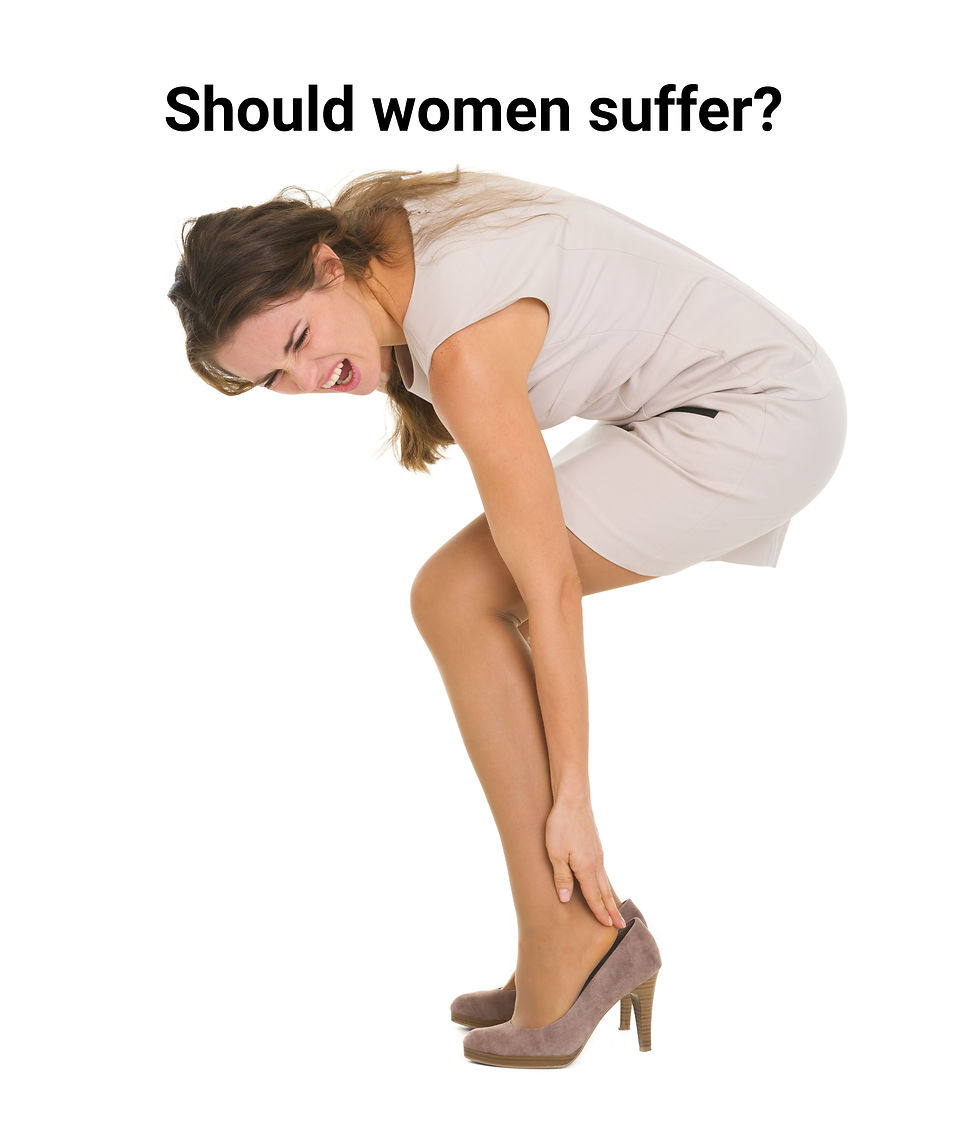
So what is our obsession with heels, and how should we react?
Bob Shepard (2015) reported from one survey that 62% of American women wore shoes with a 2-inch or greater heel on a regular basis. A collection of stories, make interesting reading from the UK to Australia, from India to Alabama. The question today really comes down to —personal choice, influence and appropriate use.
Inappropriate Influence
An RAF flight lieutenant ruptured her achilles tendon after being ordered to run with an 80 pound kit bag in high heels. She won her case for compensation at Preston crown court in the UK. Deborah Burns, now 28, was on the second day of her initial training course at RAF Cranwell, near Lincoln, in August 1996. Guardian
The case for Deborah was ridiculous and begs the further question who lost their common sense gene that day? Whose responsibility is it when it comes to using footwear? One can see that some heels just are not ideal for London’s pavement, as one female, later Prime Minister, found out (video) in 2012.
Nicola Thorp was 27 years old when she made headlines in 2017. Her bosses required her to wear shoes that were 2-4 inches high. Nicola was employed by the agency Portico. A Portico spokesman said:
In line with industry standard practice, we have personal appearance guidelines across many of our corporate locations. These policies ensure staff are dressed consistently and include recommendations for appropriate style of footwear for the role. We have taken on board the comments regarding footwear and will be reviewing our guidelines in consultation with our clients and team members. McDonnell, 2017
Retaliation and rebuttal at the time of Nicola Thorp’s event in 2017 from the College of Podiatry highlighted safety at work and was picked up by the HSE, Health and Safety Executive, a government-backed body that states that its roots date back to 1833. That would place history at the time of the Great Reform Bill (1832), which significantly altered the face of industry. The HSE published its findings (click), but the UK Government rejected calls for a ban on the enforced wearing of high-heeled shoes. McDonnell says in her article;
What has not surfaced in the debate so far has been any real objective consideration of safety. Those employers who are keen to project a "glamour" image as part of their business profile also have duties to ensure, so far as is reasonably practicable, the safety, health and welfare of their staff. Slips and trips are a major cause of falls in the workplace and falls on the level, both at work and in public spaces, have been estimated to cost the UK £1billion annually.
The Case for Safety
The TUC and Health Safety Executive have published guidelines on footwear safety. Perhaps more than anything, safety lies at the top of the list of concerns by podiatrists committed to good foot health. Researchers at Aberdeen University carried out a review of scientific studies into shoes. Data revealed that while high heels increased women's attractiveness to men, studies also showed that injury and conditions associated with the body’s muscles, joints and bones were at risk. Collectively, these are referred to as musculoskeletal conditions.
Researchers contrasted the response of the UK Government with that of the Canadian province of British Columbia, which had previously changed the law to ban employers from requiring female staff to wear high heels.
Max Barnish, at the University of Aberdeen, considered that despite the huge amount of evidence against heels, complex social and cultural reasons competed with the risks. Heather Morgan, a lecturer at the same university, believed that the message was not telling people not to wear high heels but to provide information so that users could judge the health risks and social benefits.
The lawmakers need to change the legislation in the UK, as this has already happened in Canada. No one in the workplace or a licensed public social venue should be made to wear such footwear. Here is an extract from Collins.
'In cases involving specific attire, courts often analyze whether the dress code serves a legitimate business purpose. If an employer requires high heels, courts will consider if this rule is necessary for job performance or customer perception. Additionally, courts examine whether the dress code applies uniformly to all employees or disproportionately affects a certain gender.
Overall, rulings have frequently favored employers when dress codes are reasonable, applied consistently, and not inherently discriminatory. The rulings emphasize the importance of workplace standards while ensuring compliance with anti-discrimination laws.' Jack Collins 2025
Evidence of risk
Safety, above all, is a prime mover for ensuring that we all minimise accidents at work and, of course, at home. The risk of ankle damage naturally increases as the heel height rises. Studies show that injuries due to wearing high heels (mainly sprains) have doubled over the past 10 years - evidence from Alabama study (click).
In Australia between 2006-10, Williams & Haines (2014) reported that 240 injuries had been recorded in a Victoria emergency department, where 98% were women and younger than 55 years. Injuries occurred mainly on Sundays between 8 am and 12 pm in one-third of cases. The winter season had a greater incidence, and the ankle was the most common site.
Research conducted between 2002 and 2012 at the University of Alabama showed that results from high-heeled-shoe findings mirrored those of the Australian study, which also drew on data from a hospital emergency department. McGwin, in the Alabama paper (Journal of Foot and Ankle Injuries), was cited by Shepard, pointing again to younger people suffering.
People between the ages of 20 and 29 were most likely to suffer an injury, followed by the 30-39 age group. Bob Shepard 2015
Choice
Not all women want to wear high-heeled shoes.
McLaughlin, a journalist, reacted after the Cannes Festival, where actors ‘flats’ were barred from entry at the festival’s red carpet event. This was called ‘Flatgate’. Even actress Emily Blunt was on the front page of the report. A reporter informed Blunt about a report stating that several women at the Cannes red-carpet premiere of “Carol” were turned away because the festival has a high-heels-only policy for footwear. “I think everyone should wear flats, to be honest,” Blunt said. “We shouldn’t wear high heels anymore. That’s just my point of view. I prefer to wear Converse sneakers. That’s very disappointing.”
Females, once considered shorter in stature than men, often use heels to enhance their height. However, this is not always the case, as many now tower over their male partners, reflecting a shift in societal acceptance. This had the effect of empowering some, while for others, it allowed for longer, flowing dresses. It is just as likely that some like high heels without any condition being imposed. Hadley Freeman, however states;
(if) you understandably, think women wear high heel shoes to be taller, [but] you are sorely underestimating the mental minefield that is to be a woman. The Guardian. 15 June 2015. Although high-heeled shoes might be stylish, from a health standpoint, it would be worthwhile for those interested in wearing high-heeled shoes to understand the risks and the potential harm that precarious activities in high-heeled shoes can cause. Gerald McGwin, 2015
Are there benefits to using high heels?
Cutmore, a podiatrist from New South Wales (Australia), advised health reporter for the Herald Lisa Tait (1998) that while 10cm high heels made legs slimmer, the achilles could be slowly destroyed as the tendon is shortened.
Before we ban high heels, let us consider their benefits. While Cutmore knows that a shortened tendon makes walking difficult and causes foot pain problems in flat shoes, sometimes this is not always dependent on wearing high heels all of the time. Flat feet often benefit from a heel height, as it takes the strain off the inner tendons. While these are not as powerful as the achilles, they are primary stabilisers. Moreover, plantar fasciitis is caused by regular shoes rather than high heels from my experience as a jobbing podiatrist for over 40 years.

This is a self-help book which guides you through alternative treatment, launching late summer 2025
Women Should Have The Last Word

Should High Heels be banned?
Men’s imposing attitudes on women sit poorly with today’s view on equality, and imposed use should be challenged. It seems, though, that yet again, women are forced to provide the evidence of discrimination unless the uniform is justified, reasonable and measured.
You do need to use the proper footwear for the right job. High heels should be interchanged when not required. If you so choose to use these shoes, it is your right, but there are risks, and the consequences of those risks could be long-lasting.
Here's a little secret I wish every woman knew: Our legs don't need to be elongated, clenched or upheld at a particular angle to be beautiful and embraceable. I've thought a lot about this fact since last May when I decided to stop wearing high heels for a year. Variety
McLaughlin (2015,2016) again,
I've also learned that high heels cause a whole lot more than a bit of temporary pain. Women should have every right to wear whatever shoes they wish, without judgment…I find it interesting that virtually no articles on high heel risks suggest giving them up as a viable option, much less the one sure way to prevent or minimize these problems.
McLaughlin’s female-driven blogs carry material that is hard to ignore, partly because it has been derived from professional sources. The risks associated with high-heeled shoes are emphasised in her article (click here) for a comprehensive list and more information from a predominantly female perspective.
Footwear is a personal choice, and a more comprehensive scientific study based on epidemiological information, including both health effects and risks to safety associated with high-heeled wearing, might actually help women themselves have more confidence in the shoe choices they make for the workplace.

The key to common sense can be summarised
Wear the proper footwear for the right occasion and setting.
Reduce the time of exposure and limit the time allocated to wearing heels
Carry a spare pair of shoes with lower heels for comfort, especially when driving
Examine heels for damage and fractures before wearing them each time
Protect skin and bumps from pressure
Use a small forefoot pad to reduce frictional forces on the forefoot available from pharmacists.
Avoid running in high-heeled shoes. But then that makes common sense!
Thanks for reading this article, Should High Heels Be Banned? Initially published in Podiatry Review Winter Issue 2025; 3-32. Adapted and edited for ConsultingFootPain.


Comments