
Arthritis and the Big Toe

Formal names for a stiff toe - hallux limitus and hallux rigidus
Why does your big toe hurt?
The toe can be deformed, stiff or both deformed and stiff, but it may also have changes brought about by disease.

The Humble bunion
As seen in the image, the right foot has a pronounced shape that sticks out; the left big toe is swollen and inflamed. However, the truth is that while the inside of the joint may have lost some of its healthy cartilage, few patients suffer from joint pain. The reason is that the toe is dislocating sideways, which allows it to move more freely.
The Big Toe Joint that Hurts
There are two main reasons why we suspect arthritis in the big toe:
Inflammation - creates swelling and the release of pain chemicals.
Stiffness - prevents normal function & causes changes in the foot position.
Clinically, we need to determine why a toe is stiff and whether there is an inflammatory problem, as both conditions often coexist. The discussion about arthritis being the cause may be true, but what exactly is arthritis? In modern medicine, we typically refer to arthrosis, a condition that affects the joints. There is more than one cause.
In several cases, once the toe, specifically the first metatarsophalangeal joint, becomes stiff, the pain subsides. The process between the start and the final stiffness (ankylosis) is where most pain arises.
Pain chemicals called mediators cause inflammation and swelling. An injury, such as a sudden impact on the sports field, will initiate the process. However, in other cases, it is a medical problem. The four significant causes include G.O.R.P. While there are other causes, these conditions will also often accompany some autoimmune diseases, such as arthroses associated with bowel disease, as one example.
Gout
Osteoarthrosis
Rheumatoid arthritis
Psoriatic arthritis
Gout is known as a metabolic disease. The breakdown of chemicals such as purines follows an abnormal pathway, often stimulated by rich food and alcohol. Gout is associated with the kidneys' inability to excrete uric acid. Deposits of white chalky urate material affect the synovium. The joint enlarges and is horrendously painful. The lubrication mechanism fails and the joint cartilage dries out.
Henry VIII suffered greatly as he consumed prodigious amounts of meat and required wide shoes to alleviate the pressure. Wide shoes suddenly came into fashion to keep up with the King. Gout, known as podagra, is self-limiting, but leaves behind a dried cartilage surface so that joint lubrication is minimal. The joint enlarges with gouty deposits, as illustrated.

The lining of the joint (synovium) dries up and cannot recover if gouty episodes continue. The joint will stiffen and lose its mechanical efficiency.

Cartilage & Synovium
A millimetre is the smallest measurement on a school ruler. The cartilage covering the ends of the bone making up the big toe joint is less than a mm, which is thinner at 1/16th of an inch if you use imperial measurement. That is pretty thin. The hip joint cartilage is approximately 2-3mm thick.
The joint has a tough outer lining called a capsule, and inside this lining, a thinner membrane, known as the synovial membrane (synovium), exists. The membrane does two things. First, it ensures that the joint is balanced chemically. It provides nourishment to the cartilage, keeping it healthy. If the synovium is healthy, the joint has a good chance of remaining healthy.
While diseases are directed at this critical part of the joint, as in rheumatoid arthritis and gout, to name but a couple of the common arthritides, injury can also affect the synovium.
Cartilage contains water, special cartilage cells (chondrocytes), and a spidery framework called collagen, a protein and some sugar-protein molecules that push from each other, maintaining tension. Those molecules (proteoglycans) have chondroitin and hyaluronic acid. Chondroitin is promoted as glucosamine in tablet form in health food shops. The molecules we learned about in school are simply chemicals bonded together in short or long chains. The PGs (proteoglycans) are essential for maintaining healthy cartilage. Unfortunately, as we age, the cartilage becomes brittle as the substance of collagen, chondrocytes, and PGs reduces.
Cartilage (hyaline) works with a joint that produces a thick fluid that is clear in colour and made of synovial fluid. The fluid contains hyaluronan (hyaluronic acid) manufactured by the synovial membrane. The cartilage surface has a slimy material (glycoprotein) similar to the secreted sticky trail left by snails. It is wonderful in reducing friction as the toe and bone (metatarsal) compress, twist and slide, watery content leaks from the cartilage in one direction and returns later after pressure has reduced. But, of course, this happens all of the time.
Provided that cartilage is intact, the lubrication mechanism works well. However, if the surface is damaged, the mechanism fails to work.
If the cartilage is damaged down to the level of bone, bleeding will occur in the joint. The synovial fluid will change colour and can form small clots, forming scar tissue. If you stub your big toe (turf toe), the softer tissue is damaged first. If the damage is significant or you repeatedly experience it, then the changes in the joint deteriorate. New bone may start to form around the joint, and the joint becomes non-functional when that happens.
In the condition of osteoarthrosis, the cartilage is prone to damage, more so by heredity than by injury. Small bony spurs can be seen in the fingers (Heberden's nodes), and the first toe joint may be affected. As the chemistry alters, often later in life, from the 40s onwards, the joint may stiffen. At the same time, osteoarthritis (also known as arthrosis) affects larger joints, such as the hip and knee, and is related to genetic trends and cartilage weakness.
Rheumatoid Arthritis (RA) is more cruel than other conditions, as severe RA leads to gross deformity in the foot. It is not so much the toe that hurts alone, but rather the side effect of the disease, which can also start in juvenile cases as well as later in life. Damage arises due to abnormal white blood cells attacking the synovium. The good news is that treatment has improved significantly today and can help mitigate some of this autoimmunity, where the body attacks itself. The joint specialist is a rheumatologist and many modern drugs help reverse some of the chemical problems within the synovium these are called disease-modifying medicines or DMARDS. However, the subject of rheumatology is complex and overlaps with medical issues, e.g. diabetes and thyroid hormonal imbalance. As in gout, cartilage is destroyed aggressively.
Lastly, we come to psoriasis, which is often believed to affect the skin, causing increased cell turnover that results in flaky and thick patches, accompanied by redness, typically over areas such as the front of the body. The foot is not immune to this condition, but tends to attack the small toe joints rather than the big toe.
By far the most common cause is injury, which may be a slow process. A normal toe is unaffected when the heel raises during walking. If the toe fails to move with at least 20-30 degrees, the foot will alter to compensate, setting up pressure problems elsewhere, and across the ball of the foot. The heel lift puts strain on the first toe joint.

Progress has been made by early management, followed by physiotherapy. The joint may stiffen, resulting in limited motion and pain upon movement. The joint is often stiffened by a muscle going into spasm. The spasm can be relieved by applying heat and cold, as well as splinting. This is where those toe splints really play a part in recovery.
An anti-inflammatory injection, such as a steroid, can help calm the inflammation and reduce the lining's production of excessive swelling, so nerve endings are less irritated by the mediators mentioned earlier.
Arthritis and the big toe - long-term damage
If the joint continues to receive damaging forces, it will deteriorate. The cartilage will erode away, the joint fluid will no longer lubricate and provide nutrition, and metabolites, in the form of waste chemicals, will build up, causing more inflammation, pain and swelling.
X-rays
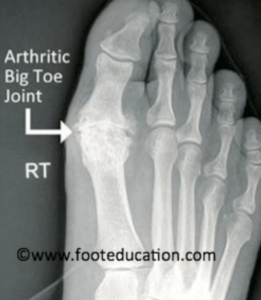
If your clinician orders an X-ray of the toe joint, it primarily helps to show how much joint space is present or lost. The excess bone produced (osteophytes) can provide a gauge of deterioration. Another feature used in X-rays is the identification of bone density or bone loss. As we age, our bones thicken, but feet are not used to gauge osteoporosis, whereas the spinal vertebrae offer a better indicator.
The cartilage is not visible on an X-ray, and specialised scans, such as MRI (magnetic resonance imaging) or CT (computerised tomography), are required to evaluate deeper levels of damage. Ultrasound are less effective when scanning for bones.
Treatment
Pain medication is temporary and acceptable for an acute injury. You hurt yourself, find that you cannot walk and take pain medication, and that’s fine.
Manage the swelling with ice packs and avoid exercise for a few days. If the pain lasts beyond 5 days or the toe joint is swollen, seek advice. In children, toe joint damage is particularly critical, as it can cause permanent damage to the joint, hindering healthy development and potentially affecting growth. Cartilage can repair in children up to a point, but not in adults. Cartilage is not like bone, which is repaired with the same material. Instead, cartilage fills in with scar tissue.
Night splints can help settle pain and prevent movement. Often marketed for the bunion. There is a wide variety on the internet marketplace.
Use a stiff-soled shoe to reduce movement for both HR and HV where there is joint pain.
Should you use glucosamine tablets, and do they work?
There is no doubt that glucosamine (a sugar-protein) is part of normal joint chemistry, but its value for everyone has not been proven scientifically. However, the general view is to try it as it will not harm. In much the same way, Vitamin D helps but is not the whole answer.
Injections
Hyaluronic acid (HLA)
While glucosamine is not a proven benefit, directly injecting a similar chemical product can assist in some cases. Again, studies have mixed results, but it is an option you can discuss with your clinician.
Laser treatment
External influence on the joint from low-level laser therapy can be beneficial and probably works on the synovium. There is a lack of evidence in human studies associated with the first toe joint.
Surgery
Joints that no longer work, are constantly painful and fail to respond to conservative treatment may respond to surgery. Joint replacement (arthroplasty) for a painful, stiff joint can be offered, or resurfacing with a silicone plug can be performed at the point of most significant damage. Alternatively, the joint can be fused to prevent movement (arthrodesis).

Conclusion
Arthrosis is a general condition, and this article covers the basics of joints and how damage affects movement as well as looking at medical conditions of which gout is the most common isolated cause.
Two features create problems — the development of extra bone (osteophytes) that block joint action, and inflammation, creating changes in the synovium (synovitis), that are vital for normal cartilage health.

Thanks for reading Arthritis and the Big Toe by author David R Tollafield.
.


Comments